
Book Collecting Guide
How to clean and preserve paperback books

That they’re easy to carry, often pocket-perfect and lightweight, inexpensive (or relatively so), and sold in drugstores, airport arcades, supermarkets, and many other venues outside the hallowed precincts of the glorious bookstore does not make them less worthy of a good life as a book. Many old and battered paperbacks are treasured by their owners, for content they can’t replace in another edition or for pure sentimental attachment. Who among us hasn’t got paperbacks that we can’t part with, even as we wonder what we can do to keep them going?
Paperbacks’ chief fault lies in the often low-grade (inexpensive) components that make them harder to preserve.
There are no government or industry mandates on the use of acid-free paper, and perhaps there shouldn’t be in a free society, but increasingly, publishers tell us, they use the better-quality stock whenever budgets allow or other considerations prevail. A savvy book shopper might look for the infinity symbol (the horizontal “lazy 8″) often found on the copyright page of contemporary books with a statement that acid-free paper has been used. Perhaps a letter-writing campaign thanking publishers for this far-sighted decision might be a good use for some acid-free stationery.
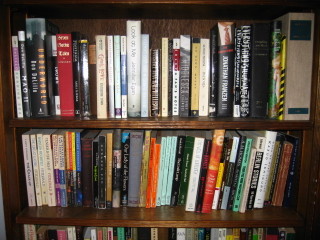
What book lovers can do in the absence of a mandate is to regulate what happens without one.
Here are ten book lovers commandments, applicable to books of all bindings and paper components, but which are perhaps especially pertinent to the survival of the potentially more fragile paperbounds:
“Thou shalt regulate temperature and humidity where books are stored.” High degrees of both temperature and humidity accelerate deterioration in all books. Paperbacks are likely to suffer first, and worse as time passes, because of their often highly susceptible physical components. A general rule: if the average human is comfortable for a prolonged period in a particular space, most books will likely live there safely.
“Thou shalt shield books from sunlight.” Ultraviolet rays, especially when there is prolonged daily exposure to direct sunlight (and even some kinds of artificial lighting), are as bad for books as they are for book lovers. If you apply sunscreen to your person, you can provide some comparable protection to your books and reduce, if not eliminate, the hazards: close window coverings, arrange hangings to cover shelves (these can be anything from an interior decorator’s extravaganza to some spare curtain fabric you can’t decide what to do with), or if possible display books where direct sun isn’t a problem, in closed cabinets or on the wall that never gets the sun.
“Thou shalt spare books from extremely dry and excessively humid conditions.” Some books, especially older paperbacks, can simply dry out and fall apart; no fun when you grab that copy of something you’re longing to consult. Humidity, with its cohorts heat and fungi, promotes mold and its dangers to books and people. Immediately isolate any mold-afflicted book, sealing it in plastic.
“Thou shalt shelve books in an upright position.” Books’ spines are comparable to ours, and how many of us benefit from the habit of good posture: stand up straight! If paperbacks blogged, they’d probably rail against being stowed wherever they can be stuffed, at any angle, packed too tight, piled one atop another like pancake stacks.
“Thou shalt provide delicate paperbacks with extra protections.” Lovely artwork or extremely fragile covers, rarity, or recognition of an old favorite should prompt you to slip that volume into an archival-quality transparent bag, cover, or sleeve for added protection from ultraviolet, dirt, pests, and many other hazards.
“Thou shalt keep them clean!” A paperback deserves periodic dusting and, as its condition warrants, additional cleaning as much as any other book, about which we have written in previous columns. A paperback’s structure, however, calls for an extra-light touch. Too much effort for a mere paperback? Not if it’s a permanent member of your family of books. The cleaner the book, the longer you may be able to enjoy it.
“Thou shalt learn about acidification.” To maintain those especially treasured paperbacks, learn about the deacidification sprays, alkaline liner paper and interleaving sheets sold by book supply vendors.
“Thou shalt attend to books that smell bad.” A range of impurities, some present in acidic book paper and others in the environment, contribute to that musty book smell. An easy fix for most such sufferers employs a solid room air freshener enclosed with books, preferably standing securely with pages fanned, in a clean, dry container; add time and patience, and you should retrieve a sweeter-smelling companion.
“Thou shalt Google key words in this article to become a better owner to your books.” Books are not just sources of learning, but individuals to be learned about.
“Thou shalt consider each book as a distinct entity.” Some paperbacks, indeed all reading matter, may be best kept and remembered as Charles Lamb advised in a letter to Coleridge: “A book reads better which is our own, and has been so long known to us that we know the topography of its blots and dog-ears, and can trace the dirt in it to having read it at tea with buttered muffins or over a pipe…”
Archived comments
To comment on this article, please use the Facebook comments tool above
-
Murder_In_Print
Great article about the need to protect and preserve paperbacks.
-
rainydaypaperback
Thanks for the specifics of taking care of paperbacks!
-
ttpbooks
Do you really mean thou shalt “not” shelve books in an upright position? If paperbacks blogged, they’d probably beg to have all their typos expunged!
-
DalesDecoyDen
Number 4 confuses me. Are libraries storing all our books incorrectly by standing them up? Was “not” meant for somewhere else?
Dale
Dale’s Decoy Den -
Speedway
Thank you, great article and information to be used….
-
maublake
Great article! Would like to add “Thou shalt not dog-ear thy pages”!
-
Wildcat
I think # 4 should be “Thou shalt shelve books in an upright position”, or perhaps “Thou shalt not shelve books higgledy-piggledy”. Shelving books horizontally may be approved by room designers, but it makes them hard to retrieve.
-
Celia
I am thoroughly convinced in this said post. I am currently searching for ways in which I could enhance my knowledge in this said topic you have posted here. It does help me a lot knowing that you have shared this information here freely. I love the way the people here interact and shared their opinions too. I would love to track your future posts pertaining to the said topic we are able to read.
-
Shawn Penoyer
Good Article! Thanks for the information!
-
Fred
It seems to me that the orange book on the lower shelf would be happier if laying down flat. Not too good for a library, but would be good for storing a collector’s copy. The orange book is going to get a kink in its back from leaning over day after day.
-
Clarissa
Very good article. I am going through some of these
issues as well..