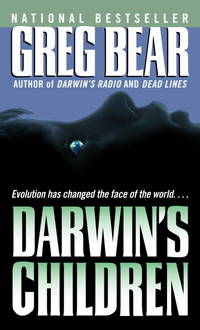
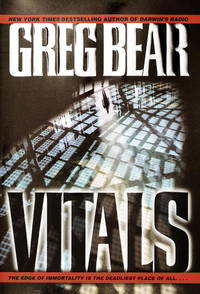
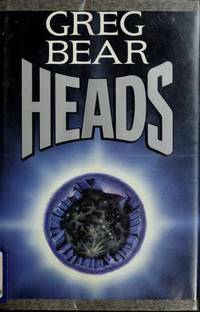
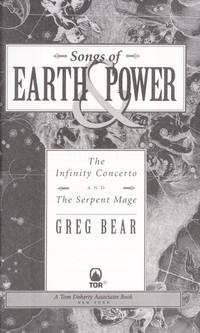
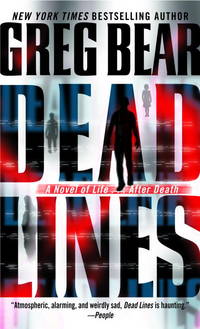
A sampling of our books by Greg Bear
Browse more from Greg Bear
Eternityby Bear, Greg
$2.00
New York: Warner Books, 1989. First Thus. paperback. Very Good/No Jacket. Moderate color chipping and bumping, front hinge a... [more information]
Corona, a Star Trek Novelby Bear, Greg
$2.50
New York: Pocket Books, 1984. First Thus. paperback. Very Good/No Jacket. Light reading crease to front hinge. Rubbing to c... [more information]
Songs of Earth and Powerby Bear, Greg
$18.00
New York: TOR Books / Tom Doherty Associates, Inc, 1994. First Edition. Hardcover. Near Fine/Near Fine. Book and dust jacket... [more information]
Legacyby Bear, Greg
$10.00
New York: TOR Books, 1995. First Edition. Hardcover. Very Good+/Very Good+. Book and dust jacket show light shelfwear, rubbi... [more information]
Moving Marsby Bear, Greg
$3.09
New York, NY, U.S.A.: Tom Doherty Associates, LLC, 1994. Read once by me. Book Description: She is a daughter of one of Mars's... [more information]
Greg Bear
(1951- )
- Books by Greg Bear (Bibliography)
Greg Bear (born August 20, 1951) is a science fiction author. His work has covered themes of galactic conflict (Forge of God books), artificial universes (Eon series) and accelerated evolution (Blood Music, Darwin's Radio and Darwin's Children). He is the son-in-law of Poul Anderson.
Bear was born in San Diego, California. From 1968 to 1973 he attended San Diego State University, from which he received an A.B. degree. In 1975, he married Christina M. Nielson, but they divorced in 1981. He remarried in 1983, to Astrid Anderson.
The scale and detailed science of his work makes clear that he should be classified as a hard science fiction author. Still, some question the scientific foundation of his work. One question is whether the bacteria in Blood Music could process enough information to become self-aware. Perhaps singly the bacteria could merely have information processing ability, and they could then develop consciousness when they grouped into colonies.
The Forge of God uses the Gaia theory freely in ways that might be considered questionable by some scientists. Neo-Darwinists such as Richard Dawkins would question the introduction of the Gaia hypothesis itself. More recent works such as the Darwin's Radio/Darwin's Children pair of novels which deal with the impact of a strange disease which appears to drive evolutionary transitions, stick closely to the known facts of molecular biology of viruses and evolution. While some fairly speculative ideas are entertained (it is after all, fiction) they are introduced in such a rigorous and disciplined way within the context of the cutting edge of those disciplines, that Darwin's Radio gained praise in the science journal Nature.
While most of Bear's work is science fiction, two of his early works, The Infinity Concerto and The Serpent Mage are clearly fantasies.
Bear was born in San Diego, California. From 1968 to 1973 he attended San Diego State University, from which he received an A.B. degree. In 1975, he married Christina M. Nielson, but they divorced in 1981. He remarried in 1983, to Astrid Anderson.
The scale and detailed science of his work makes clear that he should be classified as a hard science fiction author. Still, some question the scientific foundation of his work. One question is whether the bacteria in Blood Music could process enough information to become self-aware. Perhaps singly the bacteria could merely have information processing ability, and they could then develop consciousness when they grouped into colonies.
The Forge of God uses the Gaia theory freely in ways that might be considered questionable by some scientists. Neo-Darwinists such as Richard Dawkins would question the introduction of the Gaia hypothesis itself. More recent works such as the Darwin's Radio/Darwin's Children pair of novels which deal with the impact of a strange disease which appears to drive evolutionary transitions, stick closely to the known facts of molecular biology of viruses and evolution. While some fairly speculative ideas are entertained (it is after all, fiction) they are introduced in such a rigorous and disciplined way within the context of the cutting edge of those disciplines, that Darwin's Radio gained praise in the science journal Nature.
While most of Bear's work is science fiction, two of his early works, The Infinity Concerto and The Serpent Mage are clearly fantasies.